Thursday, January 13, 2011

Ballsy Buenos Aires


Happy new year blog readers! I had all intentions of writing this blog over the holidays and titling it “Jingle Balls”, which would have been very fitting, but things got a little crazy before my trip back to Canada.

Now that I’m back in Buenos Aires (wilting in the summer heat might I add), I thought it time to address a topic I have been meaning to write about for some time—balls. Balls in many ways figure very prominently here in Buenos Aires. First off, there is football, which is more like a religion here than a sport, and which could and should be another post entirely. But the balls I want to write about here are of another variety.

Yes, I’m talking about testes.

You see, it all started way back in Canada when I met my Argentinian husband. I spoke almost no Spanish, but I was able to pick up un a few expressions that popped up very regularly in his phone conversations. These included no me rompas las pelotas (don’t bust my balls) and hincha bolas, which literally means a swelling of the balls swell and it is used when someone is nagging you. Upon arrival in Buenos Aires, I realized that these two expressions are almost as common as how’s the weather in English.

But the prevalence of balls is not only evident language—it is also very evident in physical gestures. When posing a question or suggestion that is not welcome, it is not unusual to be met with men grabbing their balls and giving them an exaggerated shake. At this point you can safely assume the answer to your question is no. I’m not sure if the big shake would be caused by a busting, as in rompas, or a swelling, as in hincha of the balls, but the clear message is that one’s balls are not to be tampered with.

And this to me is very ironic, because I find Argentine men to be doing exactly that—tampering and tugging and shifting and scratching their balls just about any place I go. You may find me bold for writing about this, but I find it even bolder to watch these acts, which I previously considered private, in public spaces on a daily basis.

Walking down the streets, I see the porteros (door men), leaning against the door frames and shifting and scratching with pleasure while watching all the ladies go by. Riding on the bus, I see men change the ball positions almost as often as people change seats. And looking out the windows of buses, it is truly amazing what you can see – and none of it seems to be evoking any kind of embarrassment from anyone.

I have as of late started to speak my mind about all the shifting and tugging. At a recent lunch with Argentine friends, I was telling a story of being mortified with my husband for doing the exaggerated (and I mean exaggerated) shift in front of expat friends, who are less accustomed to seeing this sort of thing. Speaking as a Canadian, it’s not like I’ve never seen anyone do a subtle shift here and there, and this recent shot of famous Canadian Justin Bieber has certainly made news. But that’s just it—it made news because it’s not common to see that it public. Here, I must say, reaching down for one’s balls is like a source of pride, or even a kind of greeting. I asked my Argentine friends what this was all about.

Everyone just laughed, especially the men. I’m pretty sure that for them the whole conversation is a form of hincha bolas, and certainly served as a trigger to reach down and give things another tug. And the women? While sympathetic, they seemed resigned to the fact that a little tug here and there wouldn’t hurt anyone. I guess in Buenos Aires, that’s just how they roll.

Friday, November 26, 2010

Purple Rain

Sorry for the delay in writing posts. I hear from other bloggers that the most difficult thing about blogging is the consistency factor. But it's not like I'm not writing - I'm just writing for other venues, mostly about art. Check out some of my recent articles if you are interested:


http://www.whatsupbuenosaires.com/news/The_Art_of_Therapy

http://juanele.me/post/1552769296/last-chance-el-estado-del-tiempo

http://juanele.me/post/1431514587/juan-carlos-romeros-masks-of-suffering


The other day at an art gallery I met two people from Singapore, and we got to chatting about Asia. They, like me, had spent a fair bit of time in Japan and we were talking about how Japan and Argentina are about as culturally opposite as two countries can be. For me, the Japanese cultural systems, attitudes, sense of aesthetic, and well, just about everything, are like night and day compared with life in Argentina.

And yet, these days I find myself reminded of Japan a lot. This is due to what I like to think of as the Argentine cherry blossom - the jacaranda. I have always been obsessed with sakura (cherry blossoms). Like a true sakura junkie, I travelled to three different regions in Japan one year to catch them blooming at different times. There is nothing like sipping sake underneath a sakura tree, with petals falling around you like snow. Pure magic.

Well, the jacaranda here in Argentina are much like the sakura (minus the sake and all the hoopla that go with the sakura in Japan. Cakes are made in the shape of sakura blossoms, cards are sent out, viewing parties are planned...they sure do it up). They are similar in the sense that they bloom for a short period of time, and in that time, you are gifted with purple petals falling to the ground that create this amazing sense of beauty and peace amidst the chaos of the city.


I remember my first experience of the jacaranda last year, went I went to the Andy Warhol exhibit at the MALBA. I spent this amazing afternoon by myself looking at the well curated exhibition, which was only improved by the view outside the museum windows - a wall of purple petals falling amidst a row of jacaranda trees. When I left the museum, the sight I saw has stayed in my memory - a caretaker sweeping up all that purple as the petals fell around him. It was stunning.

Yesterday I walked from my photography class at the National Museum of Fine Arts to the MALBA for the opening of Argentine artist Marta Minujín's latest exhibition. The walk along Avenue Figueroa Alcorta, which is lined in jacaranda trees, was absolutely magical. It is like walking through purple rain. The pictures really don't do it justice.

I got to thinking about how hard to believe it was that a whole year had passed and how quickly time goes. And I was reminded that this is in fact why the Japanese are so obsessed with sakura. They bloom for only a few days and the lesson behind that is to take advantage of today - in stopping to view them, have parties underneath the trees with friends, and just enjoy the moment - because in a few days or after a strong wind, they will be gone.

In short the lesson is one that we all need reminding of: Life is short - take time to smell the sakura, or in my case, the jacaranda - because before you know it, another year will have passed.

Tuesday, October 12, 2010

Dancing through the panic


It's been over a year now that I've been living in Buenos Aires. In some ways it feels like much more than that, but in other ways, I still feel like a shiny new tourist gawking at the chaos around me.

Coming from North America, I'm aware that I tend to seem more...uptight to the Argentines in general, despite my ongoing and arduous attempt at trying to be more more like a porteña (For the record, I just bought Fernet for the first time, which, for those of you who don't know it, is a VERY Argentine thing to drink. Truthfully, I still find it all kinds of awful in just one sip, but when in Rome...).

This tendency to seem uptight comes, I think, from being from a Northern country. We are without a doubt a little more reserved in our actions. Just the other day at a party, an exasperated Argeninian cranked up the music and looked at a bunch of us expats and begged us, "OK, we've talked, now can we please DANCE? We are Argeninians and we DANCE at our parties."

It's true, I've been at many parties here, where people simply spontaneously break out in dance...be it a big or small group. People here like to boogie.

So I was not surprised by this past weekend's Festival Buenos Aires Danza Contempranea, or Festival of Contemporary Dance, but I was particularly delighted by one of the events that took place at Galeria Patio del Liceo, where I've been doing some freelance work at Ups! art gallery.

Patio del Liceo is a new and hip place for independent creative spaces-galleries, jewelry shops, book stores, etc-and on Saturday it became a contemporary dance free-for-all. As my friend Gaby, the owner of Greens, said to me upon my arrival, "There are a lot of crazy ballerinas in this place!" An effective way to describe it.

In and amongst the shops of the patio were all kinds of dancers that were, well, dancing and climbing and painting, and being painted and hanging from the rafters. Each dancer was adapting to its own particular space. In one corner a pair of dancers tied together shared a chair for a prop. Above them on the second floor, raunchy tunes could be heard from a sex shop where a crowd gathered around some burlesque-clad dancers (Sorry, I couldn't fight my way through the crowd to get a picture!). Using the spaces for inspiration and baskets of lemons for props (I never did get that...the lemons just kept circulating), the space as a whole twirled and swirled with the movement of all types of dancers.

Fighting my way through the crowds amidst onlookers and the odd break dancer, it occurred to me that the scene was a bit like a microcosm of Buenos Aires: complete chaos, yet beautiful in a way that you had to be there to understand it. Now if only I could say the same thing about the traffic!

Wednesday, August 18, 2010

Buenos Haires


A few years ago I spent a summer month teaching art history tutorials in Florence, Italy. One of the paintings I discussed was Botticelli’s Birth of Venus, which hangs in the Uffizi Gallery. You’ve all seen the painting, if not in person, than in various forms of reproduction, and I’m sure you would have no trouble recognizing the goddess and her long blond flowing locks.

In art history, Botticelli’s infamous Venus is a topic for many themes, one of which is sexuality. Now I could go into all the details about the sexual symbolism, how she is standing on a shell, etc., but I’m sure you get the picture. What what I really want to point out here is her hair and its undeniable sensuality: hair that blows in the sea breeze, hair that coils around her neck like a serpent, and hair that she uses to cover up her nudity (which of course only serves to accentuate it). It is in fact next to impossible to imagine Venus without her long hair.

It is also difficult to imagine women from Buenos Aires without their long hair. It’s pretty hard to miss when you come here to visit, but when you live here it’s in your face, both literally and figuratively, every day. Almost ALL the women have long hair. Some of them have reeeeally long hair. Some of them simply don’t cut it.

Where I come from, there are groups of women who don’t cut their hair, but they tend to live on colonies and only wear dresses. But that’s another post for another blog entirely.

What I have realized is that hair here, as it has historically, acts as a kind of sexual currency. Take my gym classes for example, which some women actually attend directly after going to the hairdresser. Instead of the North American custom of tying long hair into a ponytail to keep it out of your face while exercising, they leave it down, long and flowing, so as to be able to flip it around during the classes and be that much more appealing. It is quite something to behold. Sometimes when I’m on the treadmill I watch the classes going on through the windows and marvel at all the hair flipping, and wonder if it doesn’t get rather hot with all that hair in there, but then I note that I am one of the few women who is actually sweating in the gym.

Don’t get me wrong here – I’m not dissing the hair. I’ve never seen so much long beautiful hair before, and I’m not sure what their secret is. Maybe it’s all the protein. In any case, I do not have the penchant for having long flowing hair. Thin, wispy, and unfortunately frizzy in this climate, I’ve never hated my hair more. So what’s a girl to do? Well apparently, chop it all off.

Enter Ryan Oakley from Canada, stylist to the expat community and advocate of not looking like everyone around you. He is a master at hair and I for one don’t know what I would do without him over here. (Only in Buenos Aires do you get back from your haircuts at 1 a.m.!) Not that I needed to work hard at looking like a foreigner or anything, but now that my hair is shorter than Justin Bieber’s, it seems more obvious than ever.

I must admit, it feels a bit bare. And I guess long hair is a kind of security in a way...it clothes you like it clothed Venus. Moreover, while the other women are flipping and coiling and twisting their tresses, I’m left empty-handed.

But in the same light, it feels rather empowering to do your own thing. And fresh – just in time for spring (please let it be spring soon!). After all, it was the style guru herself, Coco Chanel who said, “In order to be irreplaceable one must always be different.”

Monday, August 2, 2010

Bag Lady

I apologize for the long hiatus. Part of the break was due to a month-long visit to Canada, and part of it is due to me finally starting to work here in Buenos Aires (at a very cool art gallery called Ups! Art Gallery. More on that in a future blog because it is a great space filled with lots of interesting art coming from some even more interesting Argentine artists). But since arriving back in the city two weeks ago, my brain has been chock-full of new impressions.

Part of the initial shock of arriving back to Buenos Aires was related to the fact that I was returning to a record breaking cold winter from spending time in the oh-so-gorgeous Canadian prairie summer. But even more shocking was going from the scene you see above (a typical scene from rural Manitoba taken by my lovely friend Tamara) to the complete chaos that is Buenos Aires.

Now aside from the obvious rural/urban difference, one thing that has really been brought to the forefront for me is the lack of concern for the environment.

I will admit it off the top. I am a prairie girl through and through. My city, Winnipeg (I call it my city, but I really grew up outside Winnipeg in the country), may have its drawbacks which include but are not limited to arctic temperatures, howling winds and fierce mosquitoes, but I still love it. What can I say? One of the things I love most about Winnipeg is its community of people committed to living in an environmentally conscious way. This is exceptionally evident at the Winnipeg Folk Festival, which I was delighted to attend.

Now, you may have read previous posts about the size of the steaks here in Buenos Aires, and the infamous asados, so you can probably appreciate how delightful it was for me to be at a place where they serve tofu burgers and tempeh bowls. But even more notable was the use of reusable plates at all the food stands and everyone walking around with their own reusable mugs. It really is amazing how much waste you can eliminate when people do their part. That festival had over 62,000 people attending and from what I could see, a shockingly small amount of garbage.

Now, I know that having lived in a co-op in Winnipeg and having friends who cut their grass with non-motorized lawn mowers may mean that I see more of an effort to tread softly on the earth than that being made by the average Winnipeger, but it still is shocking to come back to a place where it is not uncommon to see people simply toss their garbage out of the windows of buses that are belching out black exhaust fumes.

At a recent expat party here in Buenos Aires, I got to talking with some fellow expats about the differences in environmental awareness in some of our countries compared with Argentina. It most certainly has to do with education, but I still can't help but marvel at some of the things that are common here. I won't even get started on the amount of dog excrement on the sidewalk, which is an entire post on its own, and a typical conversation topic among expats.

The other, even more shocking and continually disturbing thing is that there is no recycling pick-up here in Buenos Aires. Imagine a city of more than 10 million people who drink more soda pop than any other city I have visited with no recycling pick-up. It is overwhelming. There is something in operation that acts as a kind of recycling, but it is more money driven than environmentally driven. This would be the group of people known as cartoneros, who pick through the bags of trash every night to collect materials such as cardboard and bottles that can be sold and recycled. The plight of the cartoneros is another post entirely because it is a social issue fraught with much controversy in this city. It is not easy to sit by and watch people, some of whom are young kids, pick through the garbage and pile it up on hand-pushed carts to earn what is often no more than the the equivalent of pennies.

But another thing that continues to amaze me is the insane amount of plastic bags being used and thrown away here. Just the other day I was shopping at Coto, one of the major supermarket chains in Argentina, and I watched as one of the cashiers was bagging. One pineapple, one bag; one plastic bottle of coke, double bagged; one package of individually wrapped snacks, one bag. You get the picture.

When I got to the checkout, I did my usually thing: pulled out my reusable bags and said in Spanish, "No bags please." The cashier did the usual thing and ignored me, licked her finger and started peeling off plastic bags. I politely repeated my request for no bags and the cashier looked at me like I had horns growing out of my head, shrugged and proceeded to toss my grocery items down the ramp at me, pausing only to put the milk in a plastic bag before I could stop her. "No bags please," I repeated in Spanish for the third time. "Not even for the milk?" the cashier asked? "No, not even for the milk," I replied. She shrugged as I took the milk out of the plastic bag and put it into my reusable bag. She threw that plastic bag away. Sigh.

So where to go from here? I could keep bagging (sorry, I couldn't resist!) about the lack of environmental awareness, which is probably the easiest thing to do. Or I can take the more difficult route, and just keep doing my part, little by little, and try not to get discouraged about it all. And while the landfill sites continue to fill up, I will continue to seek out new environmental options and projects like this one, which do exist but you just have to look a whole lot harder, and continue to fight the good fight where the whole plastic bag thing is concerned. I do dream of a greener, cleaner Buenos Aires, and I know many others do too.


Monday, June 7, 2010

All that Jazz

Having been out of commission for the past couple of weeks due to a wicked cold and no voice at all, I don't have much to report. Buenos Aires is a terrible city to be sick in, because while you're cooped up inside, you are well aware of the quality and quantity of activity occurring around you that you just can't take part in. While I'm all better now, I feel like I've missed out on a few weeks of life over here, and thus, am going back to some older material.

I have long wanted to write about this little jazz club in Buenos Aires called TheloniousClub after the jazz pianist Thelonious Monk. Nights out here have been some of my favourites in the city.

I'm not exactly sure what it is about the place - it's murky atmosphere lit by an infamous net chandelier; the bartenders and mozos (waiters), who seem to be having more fun than the clients; or the tasty drinks - but it's a spot well worth visitng. While I'm not a huge fan of margaritas, theirs come highly recommended. While my sister was out, we enjoyed their bellinis. But the best part about the club, of course, is the music.

I must admit, every time I've gone there, it has been to hear the same trio: Esteban Sehinkman 3, a trio that if you ever get the chance to hear, you should not hesitate. I discovered this trio because one of the members is the brother of my husband's best friend, and I am so lucky I did. Their performances are magic.

I could try to describe what their music is like, but like most jazz, you need to hear it and better yet, see it to really get it. I've always loved watching musicians communicate with each other while they're playing, and this trio is no exception. I guess part of it is the improvisation, which is always amazing to hear and watch unfold, but part of it is that it seems as though they have developed their own language of sorts.

The verb for enjoy in Spanish is disfrutar, and I'm not sure why, but it seems to hold more power than its English counterpart. Disfrutar seems to better express what the trio is doing while playing. While they never fail to provide an amazing performance, you get the sense that they would be having an equally fine time if they were just playing by themselves.

In any case, I have two of their CDs: their latest - El sapo argentino de boca ancha - and Búfalo. Both are great.

Like most nights in Buenos Aires, TheloniousClub seems to start and end late, and before you know it, the wee hours are calling you to another deep sleep, lulled by some great jazz melodies. But like I said, nights at this club have been some of my favourites.

And with that, I'll leave this post short and sweet. Now that I'm back in health, time to get out and face the music, so to speak.

Wednesday, May 26, 2010

Celebrating 200 years of celebrating

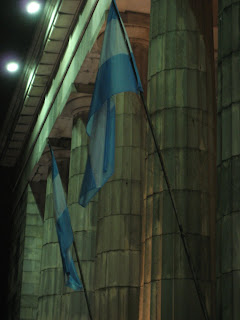
For those of you living in Argentina, I don't need to explain what this past weekend was all about. But for those of you living in other countries, we just celebrated Argentina's bicentennial. I don't think I have ever seen so many flags in my life - it's been nothing but blue and white here for the past week.
May 25 is a public holiday celebrating the May revolution of 1810, which led to Argentina's independence. This year, because the country was celebrating it's 200th year anniversary, the holiday included the 24th as well. So, a four-day weekend and millions of Argentines can only mean one thing - one hell of a birthday bash.

The long weekend made for a tough decision - to take advantage of the holiday and go on a little trip, or to stay in Buenos Aires where countless activities took place. Fate made the decision for me, as hotel vacancies were a rarity. I forget sometimes, living here in Buenos Aires, that it is much like Japan in that you always have to think ahead. Getting a last minute movie ticket on a Saturday night or on a weekend afternoon when it is raining is wishful thinking. You just have to keep in mind that there are always a million other people with the same good idea that you have.

So with that decision made, Friday night was a quick trip to closing party for an art exhibition - Clarisa Grabowiecki at Appetite Gallery in San Telmo - and then dinner at a very cool little downtown restaurant called Dada. The food was great and the atmosphere sort of reminded me of Montreal. But it was a perfect night to be in the microcentro as they call it over here, as all the big celebrations were just getting underway, and it gave me just a taste of what it would be like trying to maneuver my way around in the crowds. The Casa Rosada was lit up extra pink, roads were cut, tents were set up and people were definitely in a party mood.

But then I got to thinking, minus the flags and the tents, how is this weekend much different from other weekends in Buenos Aires? I guess I have sort of become accustomed to returning at five in the morning on the weekends. I am sort of embarrassed to admit that while living in Calgary, Alberta, I can actually remember going to bed at 10 p.m. some Friday nights. You can blame it on the winter temperatures or the abundant fresh air, but whatever the reason, people just sleep more there than they do in Buenos Aires. I'm lucky if I've even started dinner at 10 on a Friday night. All this to say that from what I have seen, people really make the most of their weekends over here, bicentennial or no bicentennial.

Saturday was supposed to be the day to leave on a trip, but since I stayed, I went to a concert at the University of Buenos Aires Faculty of Law building in honour of the bicentennial. It's a beautiful building located in an amazing area, and it was really something ascending those grand steps with all the Argentine flags flying outside to attend a concert like that for free. It was one of those moments for me when I remind myself that despite all the chaos, Buenos Aires is a pretty incredible city. After a post-concert map (napping, I have discovered, is an absolute necessity if you want to keep up with the Argentines), I attended a birthday party, which started at 10:30 p.m. Birthday celebrations, from what I have seen, are non-stop feasting and drinking and talking and dancing, topped off by cake and champagne. The night never ends early, but that is sort of a rule in this city.

Sunday I headed out on a day trip to San Antonio de Areco, a small historic city northwest of Buenos Aires. It seemed fitting to go there, a place where gauchos supposedly used to roam, to celebrate Argentina's history. My Argy husband does a lot of scoffing about gauchos, claiming they don't really exist, or at least not anymore, and are totally a way of bringing in more tourism money. I suppose it's a lot like the whole cowboy thing in Canada - trying to create some sort of culture or identity that sort of sticks after a while. So while he scoffed, I admired overpriced ponchos and listened to a very enthusiastic gaucho painter, Luis Gasparini, talk about the good old days.

I had full intentions of eventually making my way over to 9 de Julio, where all the celebrations were taking place, but after Saturday's party, and a late return from Sunday's day trip, by the time I was up and rolling on Monday and finished with a few errands, it was almost time to make dinner plans, which was done with two friends from New York who had attended the Argentina-Canada football game and left early, claiming it was one of the most boring sporting events they had ever attended. Apparently Canada was slaughtered by the Argies 5-0. I was hardly surprised, and to tell you the truth, I didn't even know Canada had a soccer team.

After a late dinner of empanadas and drinking wine into the wee hours, Monday quickly turned into Tuesday, the infamous Veinticinco de Mayo, and when I finally woke up, I was greeted with a completely congested head and a very sore throat. So I missed the parade and all the hoopla on 9 de Julio, which apparently more than 2 million people attended, but I still don't feel like I missed out on any celebrations. Besides, from what I could tell, a lot of Argentines were not in a big hurry to attend all the festivities, happy to avoid the crazy traffic and celebrate in their own way I guess.

Today in my gruelling gym class, as we all slogged along after four days of feasting, my teacher stopped the music and demanded to know what was wrong with us, and what had we done all weekend anyway? Drink endless amounts of Malbec and champagne? he asked. Well, in a word, yes, but I don't see how that differs from any other birthday party here in Argentina, or any weekend for that matter.

And with that, I'd like to close by personally wishing Argentina a very Happy Birthday. It was an honour celebrating with you and here's to 200 more!